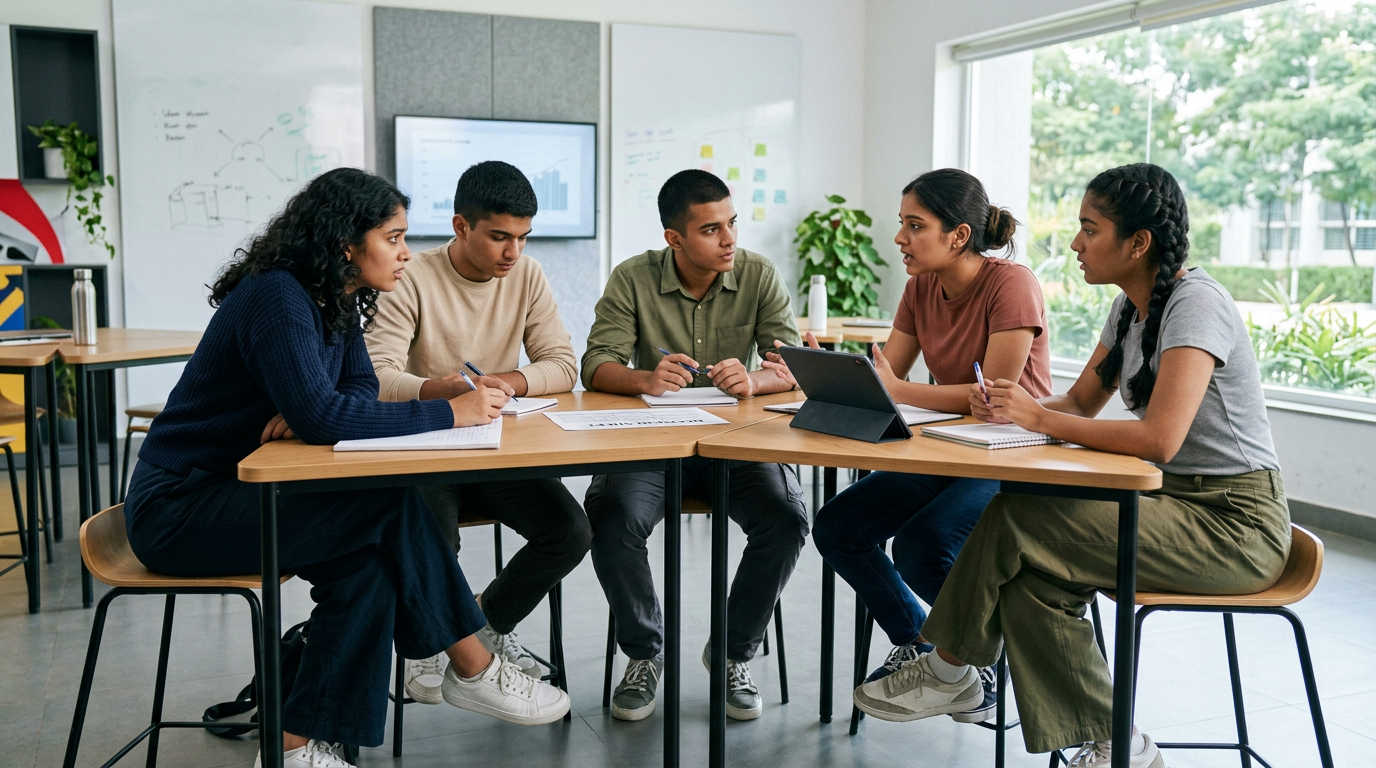
School and coaching give students a strong foundation for defined problems. Vantage sits beside that foundation — building judgement for the situations that begin where defined answers end.
Students begin by learning to notice what is shaping the situation before they rush to answer — what information is missing, what each person is protecting, and why intelligent people can look at the same situation and see different things.
Once the situation becomes visible, the difficulty changes. There is still no perfect option. Every choice protects something and sacrifices something else. Students practise making a clear move when waiting for certainty is no longer useful.
At the highest level, the goal is not to be the loudest or the quickest. It is to help the group find a way forward when every proposal has a cost, no one has the full picture, and the group could easily split.
No serious preparation is built in a fortnight. A sport, a second language, JEE/Medical prep — these are built over months, with the student’s real week happening between sessions, until the new response stops being effortful and becomes how they actually think.
Judgement under pressure is built the same way.
Vantage is paced for that. Eight live sessions across eight weeks. Between sessions, the student walks back into the rest of their week — group projects, disagreements, friendships, the moments that catch them off guard. Each session sends them out with something to try. Each one begins with what happened when they did.
The day Class 12 ends, the practice ground closes. After that, the rooms are real — the university presentation, the first-year project, the internship interview. The skills get tested before they get rehearsed.
Launchpad is for the moment after — when school has ended and the university rooms are about to open.
These are the rooms where the answer key runs out. Six people. Different views. A decision the group still has to reach. Three of the eight Vantage situations follow.
Six people are making a decision. Everyone has taken a position. The arguments sound clear. Then one piece of information surfaces — something no one knew was missing — and every confident judgement becomes incomplete. The question is no longer who was right. It is who can rethink fastest.
A student presents a recommendation. Someone pushes back clearly, in front of everyone. The room goes quiet. The test is no longer the recommendation alone. It is whether they can listen, hold their ground, and keep the room thinking without becoming defensive.
Eight people. Three different proposals. Each one is defensible. Each one protects something the others would lose. No one has enough support alone. The useful person is not the loudest voice in the room. It is the one who can find what each side is protecting — and build a way forward.
These are three of the eight Vantage situations. The full programme moves through a wider range — public challenge, trade-offs, shifting information, disagreement, and the work of building a group decision when no one has the full picture.
Across the programme, students do not just practise isolated skills. They begin to see situations differently — how people interpret the same facts, how decisions create consequences, and how a group can move forward when the answer is not obvious.
The goal is not polished performance. It is clearer judgement when the problem is shared, the information is incomplete, and every reasonable option costs something.
Understanding why intelligent people in the same room can reach different conclusions.
Noticing the assumptions, constraints, and pressures shaping the conversation before acting inside it.
Seeing what a decision may set in motion before the group commits to it.
Making a clear next move when waiting for certainty is no longer useful.
Identifying the one change that can shift the rest of the problem.
Knowing what to say, when to say it, and how to keep the group thinking clearly.
Helping a group move forward when smart people disagree and no option is clean.
Creating a structure that still works after the person who designed it leaves the work.
What makes this different is not the promise. It is the precision.
Most preparation is built around problems that have clear answers. Vantage is built around situations that have only choices — and the discipline of making good ones, again and again, in different rooms.
Each session leaves students with a practical way to read, respond, regroup, or decide. They walk out with something usable for the next difficult situation — not a motivational message about confidence.
Information is incomplete, priorities are uneven, and the group has to move while the situation is still forming. That is what makes the practice carry — real situations rarely arrive with the whole picture already clear.
The reflection after each situation does not mark students right or wrong. It surfaces what each decision protected, what it sacrificed, and what it set in motion.
Some situations demand speed. Others reward restraint. Some ask students to rethink. Others ask them to hold a group together. Across eight situations, students build range without losing judgement.
Six students. One decision. The facts look clear.
Then one new piece of information changes what everyone thought they knew.
Every option still has a cost. Every confident answer now needs a second look.
Most learning prepares students for problems that have answers. Vantage prepares them for situations that have only choices.
That is the difference between preparing for the answer and learning to move when there isn’t one.
Vantage runs in dedicated cohorts across Hyderabad. Each cohort is intentionally limited so the room remains serious, the discussion stays visible, and every student has to participate in the work.
Book a Discovery Session. A 30-minute conversation. We will walk you through how Vantage works, the kinds of situations students rehearse, and help you decide whether this is the right year for it.
Understand the programme. Ask your questions.
Scenholm · hello@scenholm.com